Measures That Matter
The first step to improving the quality of behavioral healthcare

When Americans talk about fixing the nation’s mental health system, three priorities come up again and again: reduce stigma, expand access, and grow the workforce. All of these help people engage in care. But, for me, the inconvenient truth is that when people get care, it’s often not great. We have effective, safe treatments; yet too few people in our care system get the treatment they need. So, I would vote for improving quality. And the key to improving quality is measurement.
The term of art in behavioral healthcare is “measurement-based care” or MBC. MBC is simply assessing how someone is doing while in treatment. That may sound obvious, but in behavioral health it’s the exception, not the rule. In the rest of medicine, measurement is routine. No doctor would treat diabetes without checking blood sugar or manage hypertension without recording blood pressure. Yet a review of MBC found that fewer than 20 percent of behavioral health providers use any objective measure to assess progress.(1)
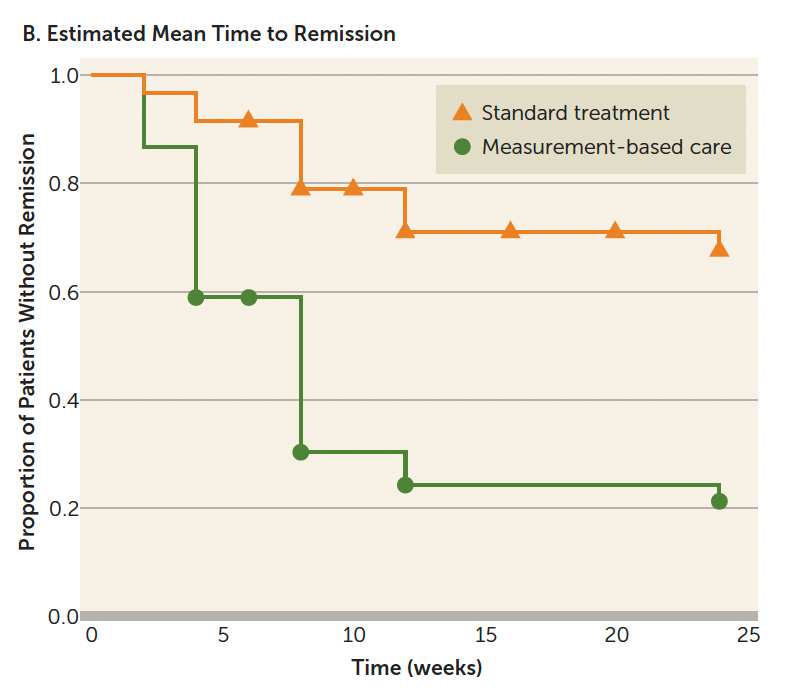
This isn’t just an academic problem. Studies show that when clinicians track outcomes, patients get better faster.(2) Here is an example from one randomized trial published in the American Journal of Psychiatry.(3) Patients whose treatment was guided by MBC achieved remission from depression significantly sooner than those receiving standard care.
While there is little debate about the value of measurement in behavioral health, there is little consensus about what to measure. In that small percent of clinical practices that measures outcomes, the PHQ-9 (a nine-item patient reported scale that asks about depressive symptoms in the previous two weeks) is the most common outcome for depression. While the PHQ-9 has been required by HEDIS as a quality standard, has become ground truth for digital phenotyping, and is now widely adopted for screening, the validity of this scale is unclear. As an example, Horvitz et al have shown using daily mood assessments that the PHQ-9 scores are only loosely correlated with mood ratings over the previous two weeks and are mostly determined by a peak rating and the most recent rating.(4) A couple years ago, Olivia Goldhill wrote a brilliant history of the PHQ-9 entitled “How a depression test devised by a Zoloft marketer became a crutch for a failing mental health system.” Ouch.
We can do better. Last week, Josh Seidman and the research team at Fountain House published a white paper entitled, Embedding Measures that Matter into Mental Health Systems. Fountain House is a national mental health non-profit that serves people with serious mental illness. (Disclosure: I serve on the Fountain House Board.) Several other groups have tried to create a consensus for mental health outcome measures, but the Fountain House team might be the first to include people with the lived experience of serious mental illness into every step of the process. What they developed was not a single scale but a framework that assessed three general areas: foundational elements, positive life changes, and service use.
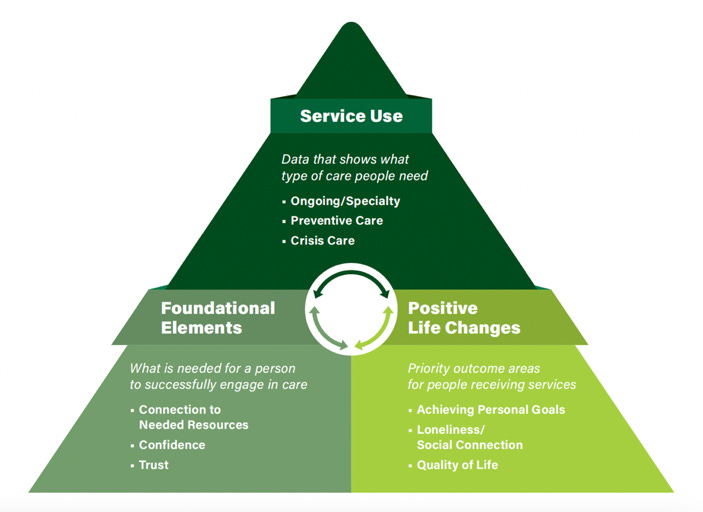
The first thing to note about this framework is that it goes beyond the mere measurement of symptoms. We know that there is a loose relationship between symptoms and functioning. The Fountain House team collects patient-reported symptoms, but they frame outcomes in terms of a person’s specific recovery goals not just their symptoms. For many people with serious mental illness, success isn’t simply “less depression.” It’s “getting back to work,” “keeping an apartment,” or “staying connected to friends.” The National Committee for Quality Assurance (NCQA) has also been promoting the Goal Attainment Scale as an important part of measuring outcomes. The Fountain House team goes even further by assessing social support and quality of life as equally important for understanding outcomes.
The Measures that Matter report also highlights Foundational Elements, like trust and confidence, that are critical for engaging in care. And by looking at Service Use, they provide data relevant to payers as well as patients. Some of these measures may be less relevant to people with mild to moderate behavioral health issues. For people with serious mental illness, engagement is a massive challenge and service use incurs huge costs, so these issues need to be part of the framework.
Of course, Measurement-Based Care raises not only a “what” question but a “who” question. Anything that creates a burden for overworked, under-resourced providers is a non-starter. Fortunately, the assessments recommended by the Fountain House team are either brief and patient-reported (like goal attainment or trust) or administrative and potentially digital (like hospital or crisis service use). And with the help of digital tools, artificial intelligence, and wearables, much of the data collection can happen seamlessly — freeing clinicians to focus on care, not paperwork. Measurement doesn’t have to mean bureaucracy. Done right, it can restore accountability — and dignity — to a field that too often operates on hunches and hope.
Defining what to measure is only the beginning. The next step — and the hardest — is tying payment to outcomes. Other parts of medicine have already made this shift to value-based care, in which providers are reimbursed for results, not volume. Behavioral health must do the same. There are risks in paying for outcomes: metrics can be gamed, and not every patient starts at the same place. But the status quo — a system that pays for visits regardless of results — virtually guarantees mediocrity.
If we truly believe that mental health care is health care, we should hold it to the same standard. We can’t improve what we refuse to measure, and we can’t reward what we never define.
The path to better mental health care begins with three words: measures that matter.
References:
1. Lewis, CC et al., Implementing Measurement-Based Care in Behavioral Health: A Review. JAMA Psychiatry. 2019;76(3):324-335. doi:10.1001/jamapsychiatry.2018.3329
2. Bonsel JM et al. The use of patient‑reported outcome measures to improve patient‑related outcomes– a systematic review. Health and Quality of Life Outcomes (2024) 22:101. https://doi.org/10.1186/s12955-024-02312-4
3. Guo T et al., Measurement-Based Care Versus Standard Care for Major Depression: A Randomized Controlled Trial With Blind Raters. Am J Psychiatry. 2015 Oct;172(10):1004-13. doi: 10.1176/appi.ajp.2015.14050652.
4. Horwitz AG et al., Peak-end bias in retrospective recall of depressive symptoms on the PHQ-9. Psychol Assess. 2023 Apr;35(4):378-381. doi: 10.1037/pas0001219.
I agree completely with this and having spent two years with CMMI funding trying unsuccessfully to get psychologists to do any measurements, we have obstacles to overcome with the clinicians. right now there is no incentive for them to do measurement, and many are very satsified with long term patients who pay each week, that is the obstacle. Payers need to reimburse for the measurements, reimburse for taking on new patients which requires discharging those who have met their goals, as well as pay for outcome. For over two decades I ran parent management training groups for parents of children with ADHD - which is one of the treatments for ADHD recommended by AAP and AACAP. We used the Eyberg scales which parents rated behavior intensity and also rated behaviors that didnt bother them so much anymore. The majority of families were D/C after the 8 weeks because their ratings were no longer in the clinical range, and we started a new group. Families seen in group were offered quarterly follow ups, as needed. However, Reimbursement was always difficult, keeping the structure, the schedule was added work, outcome was very good and we were able to serve many more families in our clinic, freeing other clinicians for cases that needed 1:1 intensive work.
I know I am rambling,
But what is needed is incentives for effective treatment, and also mote importantly changing expectations for newly licensed clincians that their role is to serve the population coming to them, not just the 20 people they will see this week. I think the core problem is we are graduating clinicians from many programs who envision themselves seeing self pay patients in a lovely office, for as many sessions as they want, with no accountability to the payers for outcome. Thus half of all doctoral level clinicians dont take insurance and do self pay.
Measurement and pay for performance is a good start, but there needs to be a systematic approach to get large numbers of clinicians to do that.