Our Copernican Year
What a Year of Smarter Machines Reveals About Human Limits—and Political Blind Spots

For Father’s Day this year, my adult son gave me Full Self-Driving software for my Tesla Model Y. I was not immediately grateful. I like driving. I was not looking for software to take over. And, like over 80% of drivers, I am convinced I am above average.
Still, at my son’s urging, I gave it a try. The lesson was swift and humbling. At stop signs, I don’t pause long enough. On highways, I hug the right lane too closely. When I’m late, I drive too fast. Hard as it is for my ego to accept, the software is simply better than I am.
Thanks to artificial intelligence, this has been a year of ego adjustments.
First came text—fluent in any language, tone, or style you can imagine. Then images, videos, podcasts. Tools that initially felt like clever parlor tricks quickly became collaborators. And just as we began reassuring ourselves that creativity, empathy, and insight were safely human domains, the data started coming in. In study after study, bots outperformed clinicians at expressing empathy and building trust. In science, from drug discovery to advanced mathematics, machines made last year’s human brilliance look distinctly… last year.
It has been a Copernican moment. We are no longer at the center of the intelligent universe.
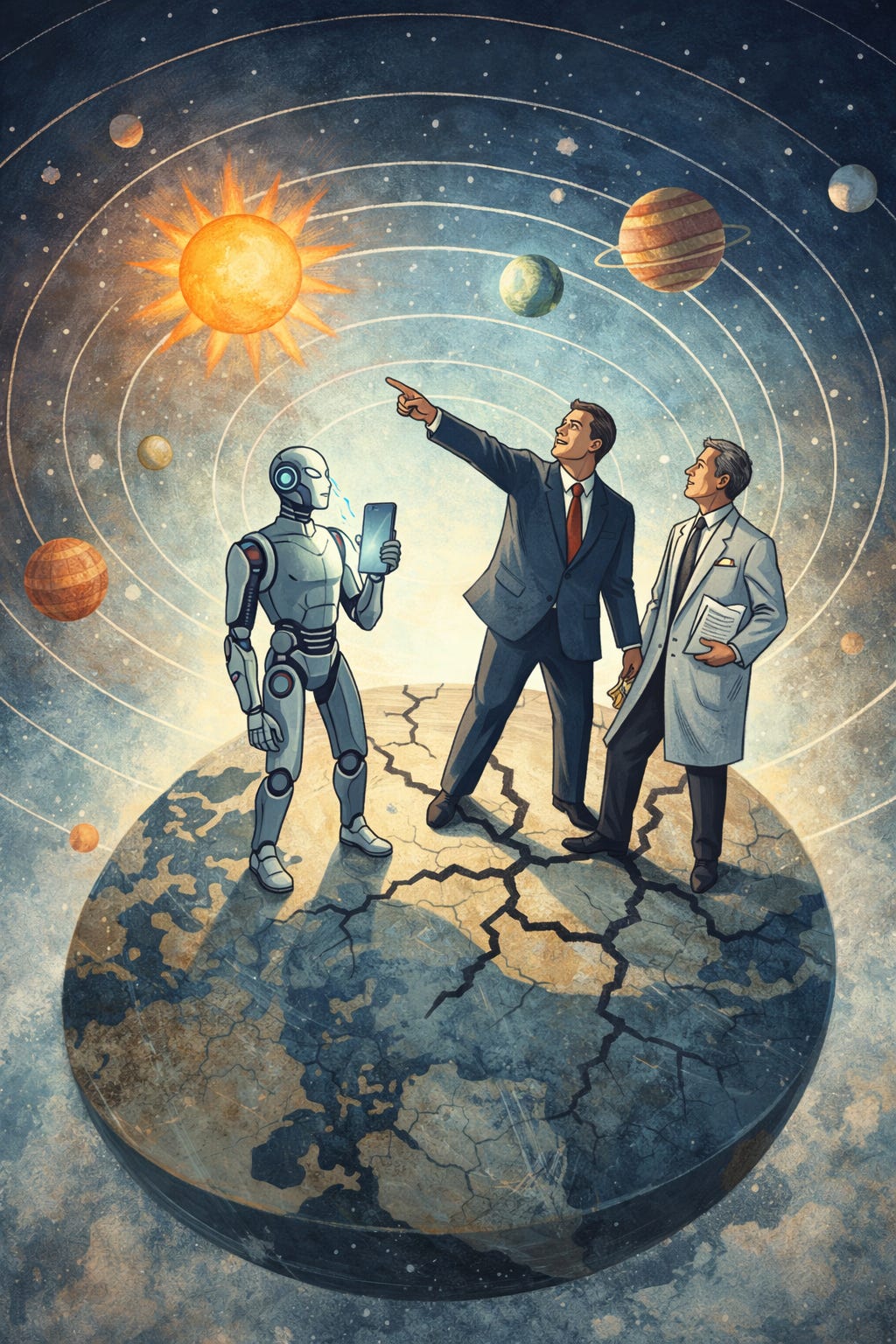
What fascinates me most about AI is not just how powerfully it outperforms us, but how it humbles and empowers us at the same time. Nearly everything I write now passes through the latest version of ChatGPT. Yes, even my holiday cards. I will confess that this very essay has been edited by ChatGPT-5.2. I thought writing was one of my strengths—after hundreds of academic papers and several books, surely I was an above-average writer. And yet the edits keep coming back cleaner, sharper, better. Each revision leaves me a little smaller. And a little stronger.
Was this the year of AI-enforced humility?
Yuval Noah Harari has argued that what makes humans unique is not intelligence but our ability to create and believe shared stories—from money to nations to human rights. We are, in his telling, storytelling apes. That raises an uncomfortable question: What happens when machines are not only more intelligent but become better at generating stories that move us, reassure us, even center us—while quietly pushing us aside? Anyone familiar with reports of AI-induced psychosis already knows this question is no longer theoretical.
There is something else curious about this moment. We are still interacting with what may turn out to be the worst large language models we will ever see—and yet they are astonishingly good at things we prize as human, like reasoning and empathy, while failing badly at things we take for granted, like memory or simple visual puzzles. Ethan Mollick calls this “jaggedness.” Map AI capabilities onto human cognition and you don’t get a smooth curve, but a serrated edge—brilliant peaks, baffling valleys. Those valleys are shrinking fast.
As 2025 comes to a close, I’m struck by a second irony. At precisely the moment when technology is forcing humility upon individuals—drivers, writers, clinicians—Americans have chosen political leaders who display almost none. Our news is now a daily pageant of certainty, swagger, and self-regard; literally a caricature of hubris and ego. Inside the Beltway, it’s Ptolemy all the way down.
If this truly has been a Copernican year, the lesson should not stop at personal enlightenment. We need leadership informed by humility: especially in healthcare, confidence needs to be tempered by evidence. The immediate risk is not that machines will become too intelligent. It is that humans will double down on arrogance just as it becomes most dangerous.
A Copernican shift does not diminish humanity—it repositions it. The question for 2026 is whether our institutions can do what our technologies already have: admit fallibility, recalibrate power, and govern accordingly. If not, 2026 may be the year of karma. And karma will be, I suspect, more humbling than AI.
AI may be intelligent and interesting, even possibly sentient but it has no identifiable gender and worse, it has no soul. A sentient being without a soul would appear to be a kin to Satan. Church Lady should weigh in on this.
Fascinating. Mind opening. I love AI. It feels like a very inexpensive administrative assistant, and publishing administrator. Thank you.